Most of the time, choosing between retractable banner stands, also known as pull-up or roll-up banners, and free-standing banner stands, or non-retractable stands, comes down to personal choice. Free standing banners allow for on-site graphic adjustments, however most retractable banners must be sent back to the manufacturer, which is one of the fundamental differences between the two, unless the retractable stand has a cassette-style base.
In addition to being exceptionally lightweight and adaptable, freestanding banners are often less costly than retractable banners. Similar to retractable banner stands, free standing banner stands are available in a wide range of designs, which, as you may have predicted, makes it challenging to choose which banner stand is the ideal choice for you. The many kinds of free standing banner stands, however, range considerably in form and general operation, in contrast to retractable banner displays, which have a very similar appearance to one another.
The terms “X banner stands” and “L banner stands” refer to the two most popular freestanding banner stands.
Three aluminium legs and two arms form the X-shaped frame of an X-Stand, which is also frequently referred to as a tension back stand. Each of the four corners of the banner graphic has grommets that hook onto the stand’s hooks to secure the graphic. When the image is mounted, the stand’s two legs and arms bend forward like a fishing pole, providing pressure to maintain the graphic flat.
An L-Stand is a three-piece stand that, when assembled, has an L-shaped back. These components include a 13″ foot, a central pole that telescopes, and a banner image. The top and bottom of the banner design have tracks that attach to the pole’s head and front side. Multiple graphics of various heights are possible thanks to its telescopic pole.
Space At Your Location
The location where you will be exhibiting your banner stand should be a primary consideration when choosing among the several varieties of free standing banner stands. If you buy a banner stand before you know what potential challenges the venue space could offer, your banner stand might be useless.
The key venue considerations are below:
Floor Space
The basic objective of a banner stand is to convey a message to a particular audience. Your banner stand will not have accomplished its goal if it is set up such that your viewers cannot see your particular design. So positioning of the flag stand is very important. It is crucial that your banner stand fits inside the available space if you want to ensure that it is placed in a location that maximises the visibility of your visual message. Before making a purchase, determine the size and configuration of your display space to be sure this is the case.
You may choose the sort of base or foot that is most appropriate for your space based on the dimensions and configuration of the display area. When floor space is at a premium, it’s crucial to exercise caution when choosing footprint sizes. Since X banners require a bigger footprint than the majority of free-standing displays, they take up a lot of space, which is undesirable if there is a limited amount of floor space. The lower size and reduced space requirements of L banners make them preferable solutions for confined locations.
Foot Traffic
Although you want people to notice your banner, you don’t want it to be so obvious that it becomes obstructive. This leads us to the second venue consideration to be aware of: attendee foot traffic. It seems sense that putting your banner stand on display in busy places would attract the greatest attention. Yes, for various types of signage like wall banners and decals. Fishing where the fish are, though, shouldn’t be taken too literally among a sea of event goers when it comes to banner stands.
Attendees won’t pass by your banner stand if they have to make an effort to do so, and instead will see it as an impediment rather than a tool to display your messaging. Additionally, this gives visitors the chance to trip over your banner stand or maybe knock it down. This might harm the stand and/or graphic in addition to being dangerous for your guests. You should avoid this by staying away from busy locations where there’s a chance that you’ll obstruct stairs, entrances, or pathways.
When it comes to being more environmentally friendly, we all want to do as much as we can. Now more than ever, we are at a crucial point in determining the future of our planet. So how can you create eco friendly advertising without compromising on quality or message, but helping the environment at the same time? We have some answers for you!
Make Your Advertising Reusable
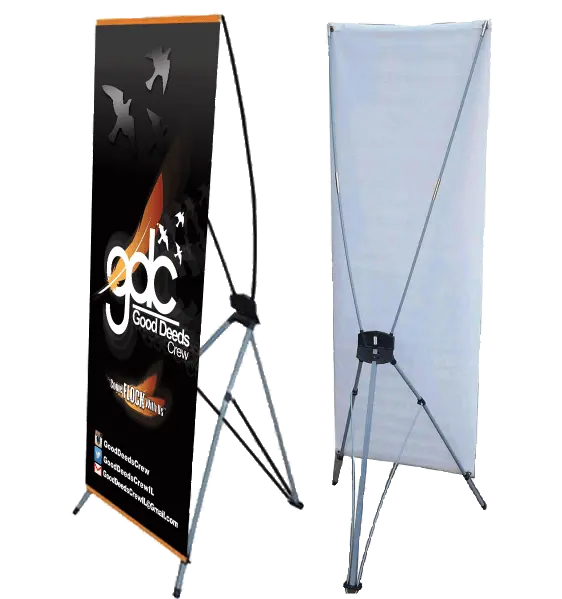
Rather than having single-use promotional material, consider investing in advertising that you can use time and time again. An advertising flag or banner that will always be relevant, for example with your company name, contact information and logo, can be used in any place at any time, whether outdoors or indoors.
Invest in banner frames which allow you to swap graphics in and out. This will not only keep your expenditure low, as you will be able to reuse the frame again and again, it will also keep your message fresh and interesting.
Consider creating advertising graphics for times of year, promotions, sales, offers or special events. Store these panels safely and simply switch them into your frame, depending on the time of year. A banner frame with alternate graphics will go a long way to achieving eco friendly advertising.
How to Store Banners Safely
If you want your advertising materials to be reusable, it’s crucial that you look after them. Here are 3 top tips on how to store banners safely, so they can be reused time and time again:
1. Clean
A banner can be easily cleaned using mild soap and water and a soft cloth, such as microfibre. Ensure you never clean a printed banner with detergents or solvents as this will destroy the ink. Take care to not use anything abrasive, like a scourer, as this can remove the waterproof layer and affect the print quality and clarity.
2. Pack Up Your Banner Safely
After cleaning, ensure the banner is fully dry before packing it away. If it is put away damp this will cause mildew or allow the graphic to stick to itself, damaging the print. Do not fold your banner, as this causes creasing which will impact the overall look and clarity of your design. Use protective paper to cover the printed side of the banner. The ink side must not come into contact with other parts of the print as it may stick to itself and rub off the lettering.
Roll up the banner loosely and evenly, keeping the lettering and graphics to the outside to prevent letter separation and air bubbles. Store in its original packaging or a cardboard tube.
3. Store Your Banner Safely
Keep the rolled up banner in a dry and cool place, below 25 degrees. Make sure nothing is placed directly on top of the banner, and nothing squashes it from the side.
Choose Printers That Are Eco Friendly

There are a lot of ways that printers can be environmentally friendly, so it’s best to use a company that has a commitment to the environment for your printed products. Ways in which a printing company can be eco friendly include:
Carbon Neutral Deliveries
As banner printers, we deliver our products far and wide. As such, it’s inevitable that we’ll need to use transport to get your products where they need to go. This can all add up to a lot of carbon emissions. Choose a printing company, like us, that uses DPD courier services. DPD are committed to making carbon neutral deliveries, and offset their carbon footprint by investing in renewable energy.
Cutting Out the Middleman
Some banner printers outsource various stages of the production process, whether design, printing etc. At Xbanners.co.uk, we do everything under one roof in our factory in Hampshire. This means the product isn’t to-ing and fro-ing, cutting down on carbon emissions. It’s also good news for the buyer, as it allows us to keep expenses, and therefore costs, down.
FSC Certified Paper Stocks
Make sure you’re working with an FSC accredited printing company. As experienced banner printers, we are FSC certified. This means our paper stocks come from managed and monitored forests, helping to create sustainable paper.
Vegetable Inks
Lithographic inks can be made from a range of different things. To offset the carbon footprint, it’s best to use sustainable inks. We use 100 percent vegetable lithographic inks, to ensure our commitment to the environment.
Recycling
Printers deal with a lot of paper, so make sure yours has a commitment to recycling. At X banners we not only recycle paper stocks, we also recycle ink cartridges through specialist companies.
Choose Biodegradable Materials

One of the best ways to achieve eco friendly advertising is to avoid using materials that will take a long time to decompose. We all know the dangers of single use plastic. A single use cup, used for 10 seconds, can take up to 500 years to break down. And, if that single plastic cup finds itself at the bottom of a landfill site, it might take even longer. Plastic needs UV to break down, so if it’s getting no sunlight, it’s not going anywhere.
Consequently, it’s best to use biodegradable materials for your eco friendly advertising. But which materials are biodegradable? Obvious options include paper, Kraft and card, all of which will begin to biodegrade in a matter of weeks. Recently, there’s been a big rise in the use of bamboo alongside more traditional materials, such as wood and cork. All natural bioplastics are also taking off, a plastic-like material made from all plant material.
At first glance, you might not think your standard banner is biodegradable; PVC takes years to decompose, as we know. However, we offer an alternative material called Envirotech which is PVC-free. This is made with a polyester base and as such it does not contain any SVHC. Consequently, this type of eco-friendly banner will decompose much faster than one that is PVC based.
Offset Your Carbon Footprint

If you’re concerned about the impact of your marketing materials, and you can’t manage totally eco friendly advertising, don’t panic. There are various ways in which you can commit to offsetting your carbon footprint. Consider planting a tree for every one of your advertising orders, or donating a portion of your profits to an environmental charity.
Alternatively, you can offset your carbon footprint through taking actions at your office. Allow staff to hybrid work, meaning some days they can work from home. This will remove some of the emissions from staff driving in every day. Similarly, commit to using eco-friendly cleaning products, plant window boxes with bee bombs or incentivise carpooling or taking public transport through offering subsidies. By creating a more eco-friendly office or factory, you can offset the carbon footprint created by making and printing your advertising materials.
If you have any questions about how our Envirotech banners or reusable banner frames can help with your eco friendly advertising, don’t hesitate to get in touch with our friendly team today!
